Texas Cooling Help
A lit single-story brick ranch house with an attached garage photographed from the street at dusk, flanked by large mature oak trees.

Heat Pump Repair in Dallas, TX

Tell us about the job

Takes about a minute. No obligation.

Step 1 of 3: Equipment

Check the thermostat and the breaker first

Set the thermostat to heat or cool, whichever it should be doing, and move the setpoint well past room temperature. If the outdoor unit still doesn't start, go check the breaker panel. Heat pumps run on separate breakers for the outdoor unit and the air handler, and either one can trip without the other.

Look at the outdoor unit and the filter

Walk outside and see if the fan is spinning and if ice has built up on the coil. A heat pump that's frozen over or surrounded by leaves and debris is telling you something specific. Inside, pull the filter and hold it to the light. A clogged filter restricts airflow and can cause the exact symptoms that get mistaken for a bigger problem.

5 months
November through March, your system heats
6 months
May through October, it cools
38°F
the average winter night it heats against
94°F
the average summer afternoon it cools against
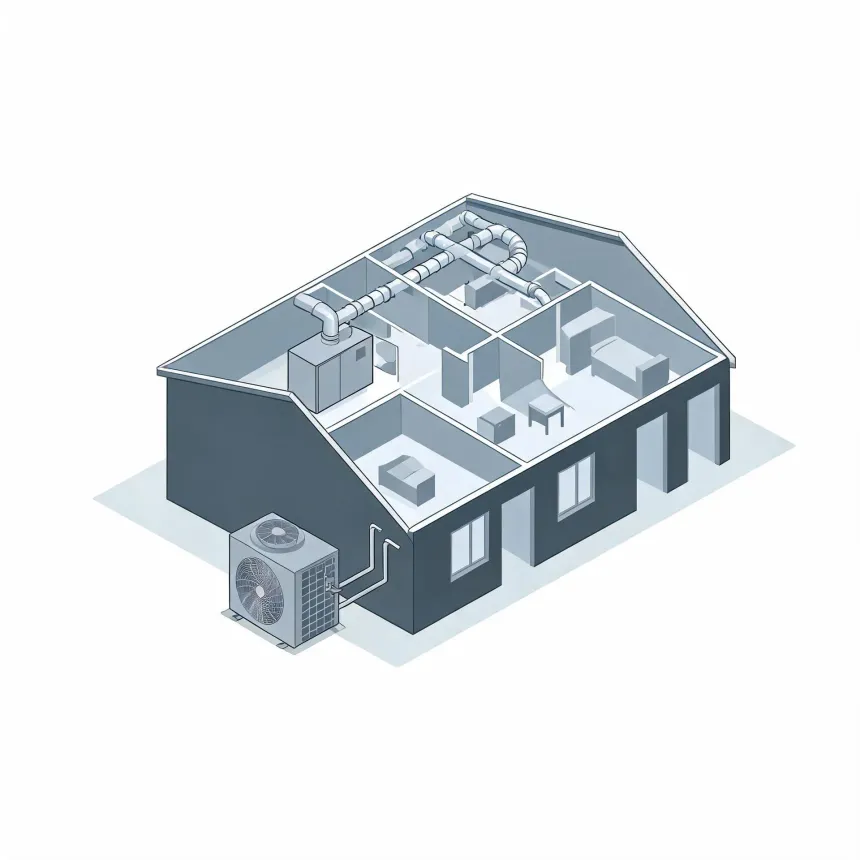
Isometric cutaway illustration of a single-story house showing interior rooms, attic ductwork and an air handler, with an outdoor condenser unit connected by lines along the exterior wall.
Your system heats November through March and cools May through October.

NOAA nClimDiv, 1991–2020 normals

Dallas County logged 186 hail events between 2015 and 2024.

Hail damages the outdoor coil and fan blades, and a heat pump running on a dented coil won't hold its charge right.

Dallas doesn't ask anything unusual of a heat pump beyond the hail

Power costs 14.94 cents a kWh statewide
186 hail events from 2015 to 2024
Climate zone 2A

April is when Dallas County heat pumps get asked to switch over and start cooling, and that first stretch of hot days finds whatever was already marginal. A capacitor that limped through a mild March can give out once the system runs for hours instead of minutes. Same story in October, the month before heat turns on here. A system that sat idle on the heat side since March doesn't always come back clean, especially if a part was already weak when it shut down for the summer. If your heat pump is acting up right at the start of one of these runs, that timing is the clue, not the weather itself.

A newer house usually means a heat pump worth repairing

Half the homes in Dallas County were built in 1983 or later. If that's when your house went up, your heat pump likely isn't the original one, but it's also not pushing against a worn-out house around it. A repair on a system like that is usually money spent on a machine that still has years in it.

Find a contractor
A man seen from behind in a dark jacket, tan work pants and boots climbs wooden porch steps toward an orange front door, carrying a waxed canvas tool bag, with a potted shrub beside the entry.
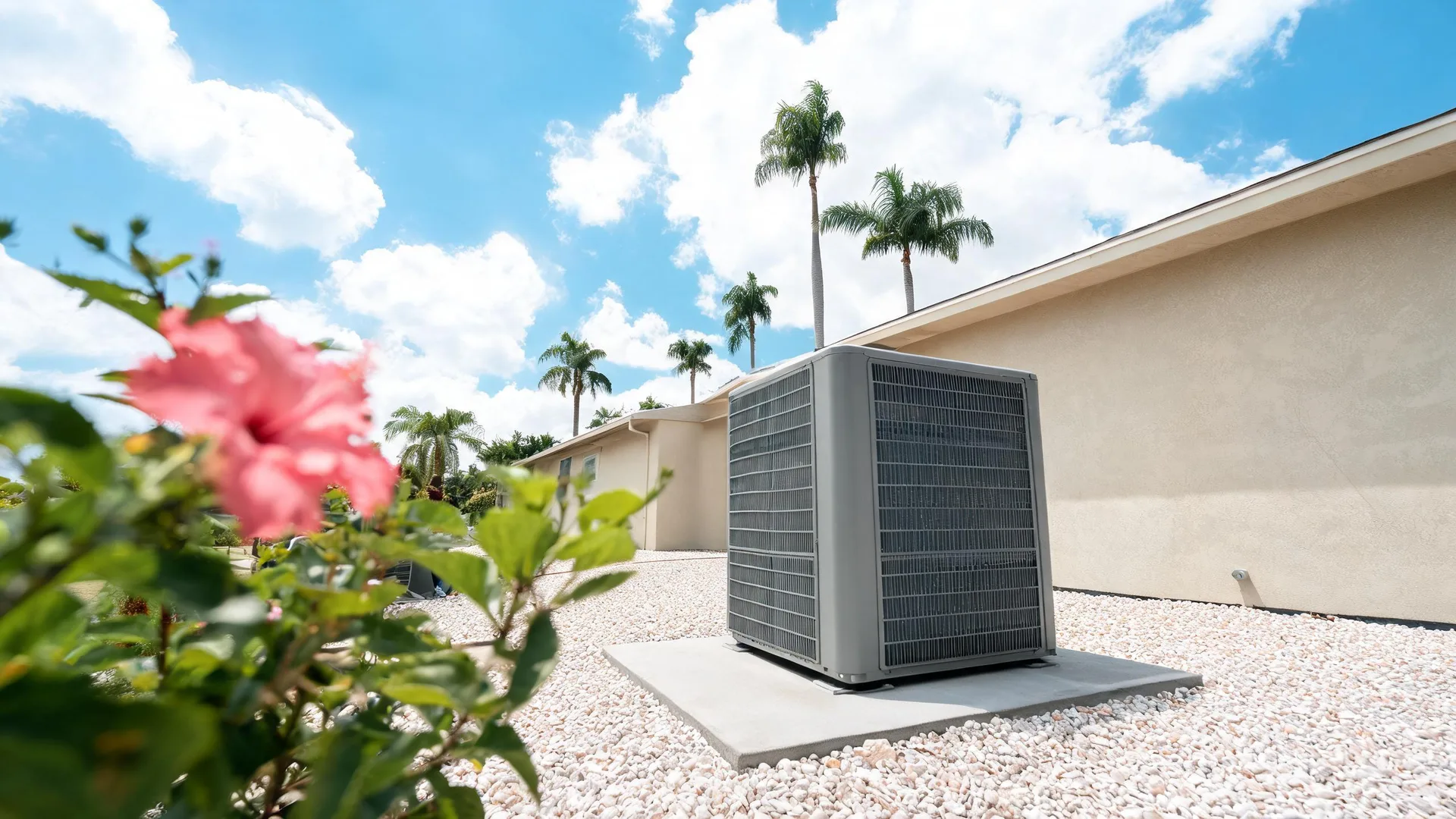
A gray heat pump outdoor unit mounted on a concrete pad next to a residential house with lap siding and stone accents.

Confirm the age, then repair with confidence

If the house checks out as 1983 or later, get the repair quote and move on it. A contractor can confirm the heat pump's age from the data plate on the outdoor unit in a few minutes. Worth asking for that number before any work starts, so you know what you're actually paying to keep running.

It's blowing air that isn't the right temperature

A heat pump in heat mode should feel warm at the vent, not lukewarm or cool. In cooling mode the air should feel noticeably cold. Air that feels about the same as room temperature usually means the system is stuck in defrost, low on refrigerant, or the reversing valve isn't switching fully. That valve is what tells the unit to act as a heater or an air conditioner, and when it sticks partway, the system runs without doing its job.

It's making a sound it didn't make before

A click at startup and a steady hum while running are normal. A hard clunk when the reversing valve shifts, a grinding or squealing from the outdoor fan, or a rattle that speeds up with the fan blade usually points to a specific worn part rather than something that will quiet down on its own. Letting a bearing or a bent blade keep running tends to turn a small repair into a replacement for that part.

Most heat pump failures come down to a handful of parts that wear out doing their job, not some hidden flaw in the system. The capacitor that kicks the compressor and the outdoor fan motor on takes a small jolt every single cycle, and after enough cycles it weakens until the motor can't start on its own. The reversing valve shifts back and forth between heat and cool every time the season or the thermostat calls for it, and that constant switching is exactly what wears out its seals. Refrigerant lines don't use up refrigerant, so a system that's low almost always has a leak somewhere in the coil or the line set, and it'll keep running low until that leak gets found. Contactors pit and burn from arcing every time they close, the same way a light switch eventually gets sticky after years of flipping. None of this means something was done wrong. It's just what happens to parts that cycle on and off for years without a break.

A diagnostic starts with gauges, not guesses. The contractor hooks up a manifold to the outdoor unit and checks the refrigerant pressure against what the system is supposed to be running, both on the low side and the high side. That number tells them if the charge is right, if there's a leak, or if the reversing valve is passing refrigerant when it shouldn't be. From there they move to electrical readings. Amp draw gets checked on the compressor and the fan motor, the capacitor gets tested under load instead of just eyeballed, and the contactor points get checked for pitting. Airflow gets checked too, since a reading that looks like a refrigerant problem sometimes clears up once a dirty coil or a blocked return gets fixed. The point of all this is to find the one part actually causing the symptom, not to start swapping parts and see what helps.