Seven months of summer
Your AC runs from April through October here. Through June, July and August the afternoon high averages 93°F. That's a long stretch for any system to carry the full load of a house, with little break in spring or fall.
Takes about a minute. No obligation.
Your AC runs from April through October here. Through June, July and August the afternoon high averages 93°F. That's a long stretch for any system to carry the full load of a house, with little break in spring or fall.
Months of running near its limit wears a system down faster than one that gets real rest. What looks like a sudden breakdown is usually a weak capacitor, a low charge, or a motor that finally gave out under the load.
NOAA nClimDiv, 1991–2020 normals
Half the homes in Montgomery County were built in 2004 or later.
If your AC came with a newer house, it's probably not old enough to be the reason it's failing.



Montgomery County has logged 119 severe weather events between 2015 and 2024, and damaging wind was behind most of them. Hail has hit the area too, and hail is hard on a condenser. It bends the fins across the coil and can dent the cabinet, and a unit can take that kind of hit and keep running for a while before the airflow loss catches up with it. If your outdoor unit sat through a hailstorm or a bad wind event this year, even one it seemed to shrug off, it's worth having someone check the coil and the fan blade before the next heat wave finds the weak spot.
Cooling starts in April here and runs through October. Problems tend to surface in the first weeks of that stretch, when the heat finally leans on a part that was already weak. Having it checked in March catches that before the first real load does.
Find a contractor
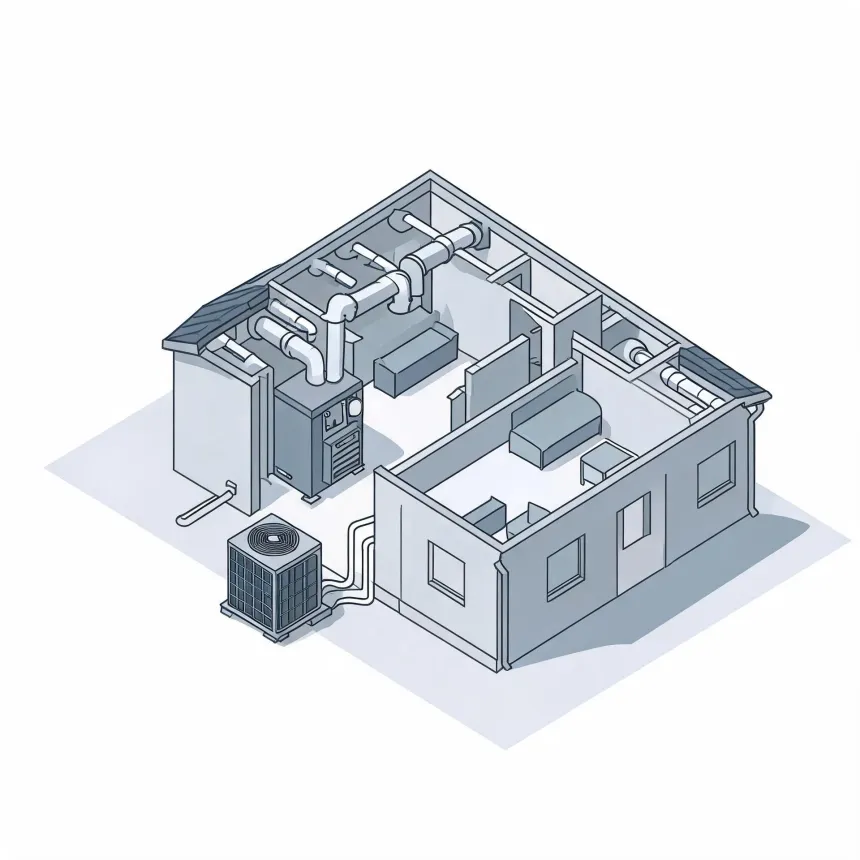
When a repair tech opens up your condenser, they're looking for exactly what seven months of 93 degree afternoons would wear out first. A capacitor that's lost its charge. A contactor with pitted points. A motor bearing that's starting to drag. These don't usually announce themselves ahead of time, so the right call is to have someone check the parts that take the load, not just reset the thing and hope it holds.
The air coming out of the vents turns warm, or weak, or stops matching the thermostat setting. Sometimes it's a sound instead. A hard click when the compressor tries to start and fails. A hum with no air moving. A rattle from the outdoor fan. None of these mean the same thing every time, but all of them mean something inside has already started to fail, not just drifted out of adjustment.
A system that's struggling usually runs longer to do the same job, and that extra runtime loads the parts that haven't failed yet. A weak capacitor that's still limping along will finish off a compressor if it's left in place. Short cycling, where the unit kicks on and off in quick bursts, wears the contactor and the compressor both. The part that's failing rarely stays the only part that's failing.
Estimates for a typical Montgomery County home, compared with an older unit built to the previous federal minimum, from EIA household energy data, Texas fuel prices and NOAA climate normals. Your home will differ.
Repair makes sense when a part like a capacitor or contactor has failed.
Replacement makes sense when the compressor has failed or the system uses R-22 refrigerant, which is no longer made.
A diagnostic visit starts outside at the condenser, not inside at the thermostat. The tech will kill power at the disconnect before touching anything, then pull the panel and check the capacitor's output against what it's rated for. That single part fails more often than anything else in the unit. From there it's the contactor, checked for pitting, and the wiring for any sign of heat damage. Refrigerant pressures get checked with gauges on the lines, since a low charge points to a leak somewhere in the system rather than a part that simply wore out. Inside, the tech checks the evaporator coil and the blower, because warm air at the vents can start outdoors or indoors, and there's no point guessing which.