Electricity here isn't cheap
Texas homes paid about 14.94 cents per kilowatthour in 2024. An AC that runs most of the day all summer turns that rate into a real number on the bill, month after month.
Takes about a minute. No obligation.
Texas homes paid about 14.94 cents per kilowatthour in 2024. An AC that runs most of the day all summer turns that rate into a real number on the bill, month after month.
A new system is a chance to pick one that uses less power to do the same job. In Dallas, where the rate is high and the unit runs hard, that choice shows up on every bill that follows.
NOAA nClimDiv, 1991–2020 normals
The SEER2 number on the label tells you how much cooling the unit delivers per unit of power, not how big or how strong it is.
A higher rated system can cool a house just as well as a lower rated one, while pulling less electricity to do it.




Dallas County falls in climate zone 2A, a hot zone where cooling is the main load on the system all year. That puts it in the Southeast region for efficiency rules, and the minimum there is higher than the national one. A new split system under 45,000 Btu/h installed here has to meet 14.3 SEER2, not the 13.4 that applies in cooler parts of the country. That floor is set before a contractor ever opens a catalog. Whatever gets installed, it has to clear that number first.
Cooling runs six months here, May through October, with afternoon highs averaging 94 in June, July and August. A system sized or installed wrong will show the strain sooner in weather like this. Dallas County also sees frequent hail, so outdoor equipment takes a beating beyond just the heat. Get the sizing and the installation right from the start.
Find a contractor
A contractor sizing this system needs real numbers on the house, not a guess off the square footage. Too big and it cools the air fast without pulling the moisture out, so the house feels damp even at the temperature you want. Too small and it runs flat out all day from May to October trying to catch up. Either way the strain shows up sooner here than it would somewhere milder. Ask whoever quotes the job to walk through how they landed on the size, not just what size they picked.
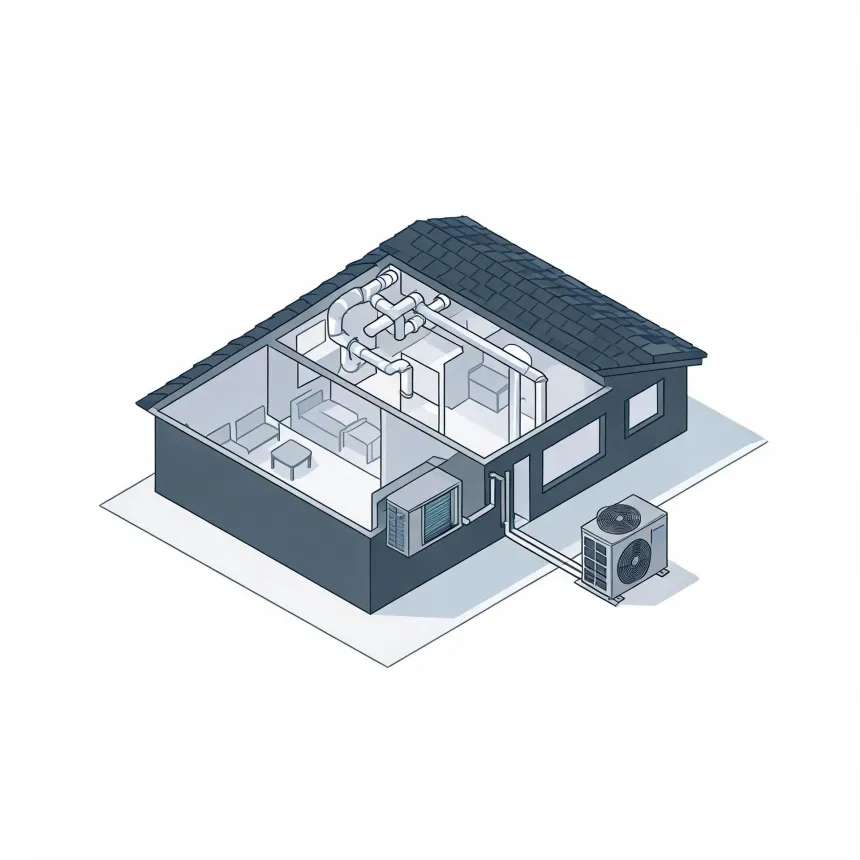
The condenser, the coil, the air handler and the refrigerant lines cost a fixed amount once you pick a size and an efficiency level. What changes the number more is everything around them. A line set that has to run further than the old one. A disconnect or breaker that needs upgrading to match the new unit's draw. A pad that has to be leveled or replaced. None of that shows up until someone is actually at the house looking at what's there.
A contractor matching new equipment to old ductwork is working with what's already run through the walls and attic. If the ducts are undersized, leaky, or sized for a different tonnage, the new system can't deliver what the label promises no matter how well it's installed. Sealing or resizing ducts costs more than swapping equipment alone. Skipping it means paying for capacity the house never gets to use.
Estimates for a typical Dallas County home, from EIA household energy data, Texas fuel prices and NOAA climate normals. Your home will differ.
On install day the old system comes out first. The contractor recovers the refrigerant from the old lines before anything gets disconnected, since it's against the law to vent it into the air. Once the old condenser, coil and air handler are out, they'll check the line set, the disconnect and the pad before setting the new equipment, since those are the pieces that sometimes need work alongside the swap. Setting the new condenser and connecting the lines takes a few hours. Then comes the part that decides whether the install was done right. The contractor pulls a vacuum on the line set to clear out air and moisture before the refrigerant goes in. Skip that step or rush it, and moisture left in the lines can break the system down early. Once it's charged, a tech checks the refrigerant level against what the manufacturer specifies for that line length, not just by feel, and runs the system through a full cycle to make sure the airflow and temperature split are where they should be before calling it done.